
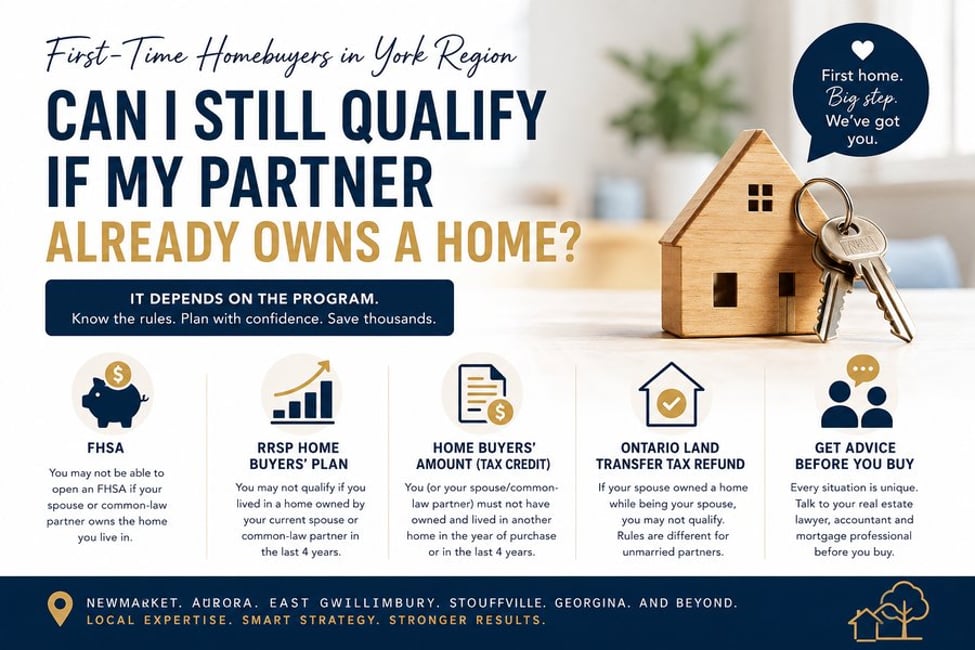
Can I Still Be a First-Time Homebuyer if My Partner Already Owns a Home?
If you are buying your first home in York Region, maybe in Newmarket, Aurora, East Gwillimbury, Stouffville, Georgina, Markham, Richmond Hill or Vaughan, and your partner already owns or owned a home, the answer is not a simple yes or no.
Here’s the thing: “first-time homebuyer” does not mean the exact same thing for every program.
You may qualify for one first-time buyer benefit and not another. You may qualify federally but not provincially. You may qualify if your partner is just your boyfriend or girlfriend, but not if they are your spouse or common-law partner. And sometimes, whether you lived in the home matters just as much as whether your partner owned it.
This is one of the most common areas of confusion for first-time buyers in Ontario.
So let’s break it down clearly.
The quick answer
If your partner already owns a home and you buy a home together, your first-time homebuyer status depends on four main things:
Are you legally married or common-law?
Did you live in the home your partner owned?
Was the home your principal residence?
Which first-time buyer program are we talking about?
For CRA purposes, “common-law” generally means you are living together in a conjugal relationship and have lived together for at least 12 continuous months, or you have a child together in certain circumstances. (Canada)
For Ontario land transfer tax purposes, the spouse definition is different. Ontario’s land transfer tax guide says spouse includes married spouses and people who have cohabited continuously for at least three years, or are in a relationship of some permanence if they are the parents of a child. (ontario.ca)
That difference matters.
Why this matters for York Region first-time buyers
In York Region, many first-time buyers are not buying alone. They may be buying with:
a spouse
a common-law partner
a fiancé
a boyfriend or girlfriend
a parent helping on title
a partner who already owns a condo
someone who owned a home years ago
This comes up all the time for buyers looking at Newmarket townhomes, Aurora condos, East Gwillimbury detached homes, Stouffville freeholds, Georgina starter homes, or Markham and Richmond Hill condos.
The issue is not just whether you feel like a first-time buyer. The issue is whether each government program agrees with you.
1. The FHSA: First Home Savings Account
The First Home Savings Account, or FHSA, is one of the most powerful tools for Canadian first-time homebuyers. Contributions are generally tax-deductible, and qualifying withdrawals used toward a first home can be tax-free.
But the partner ownership rules are very specific.
Can I open an FHSA if my partner owns a home?
Maybe.
To open an FHSA, CRA says you must be a first-time homebuyer. For this purpose, you cannot have lived in a qualifying home as your principal residence that you owned or jointly owned in the current year or previous four calendar years. You also cannot have lived in a qualifying home as your principal residence that your spouse or common-law partner owned or jointly owned in that same period. (Canada)
So if your spouse or common-law partner owns the home you live in, CRA says you may not qualify to open a new FHSA. CRA gives the example of Carlos, who lives with his common-law partner in a home owned by that partner; Carlos is not considered a first-time homebuyer for opening an FHSA. (Canada)
What if I already opened my FHSA before moving in with my partner?
This is where it gets interesting.
CRA’s definition for making a qualifying FHSA withdrawal is different from the definition for opening the account. For a qualifying withdrawal, CRA looks at whether you lived in a qualifying home that you owned or jointly owned in the current year before the withdrawal, except the 30 days immediately before, or in the previous four calendar years. The spouse or common-law partner ownership wording is not included in that FHSA withdrawal definition. (Canada)
CRA also says that if you are buying with another person, including a spouse or common-law partner, both people can make qualifying withdrawals from their own FHSAs as long as each person meets the withdrawal conditions. (Canada)
In plain English: if you opened your FHSA while you were eligible, your partner’s later homeownership may not automatically stop you from using your own FHSA for a qualifying withdrawal.
That is a very important planning point, and it is worth confirming with your accountant or financial advisor before making the withdrawal.
2. RRSP Home Buyers’ Plan: Can I use my RRSP if my partner owns a home?
The Home Buyers’ Plan, or HBP, allows eligible buyers to withdraw money from their RRSP to buy or build a qualifying home. CRA currently lists the maximum HBP withdrawal as $60,000. (Canada)
But the spouse/common-law rule is stricter than many buyers expect.
CRA says you are considered a first-time homebuyer for the HBP if you did not live in a qualifying home as your principal residence that either you owned or jointly owned, or that your current spouse or common-law partner owned or jointly owned, during the current calendar year before the withdrawal or the previous four calendar years. (Canada)
So if you are trying to use the RRSP Home Buyers’ Plan and your current spouse or common-law partner owns the home you live in, you may not qualify.
CRA is also very direct about this point: if your current principal residence is a home owned and occupied by a new spouse or common-law partner, you will not be able to make a withdrawal under the HBP. (Canada)
3. Federal Home Buyers’ Amount: The tax credit
The federal Home Buyers’ Amount, also known as the first-time home buyers’ tax credit, is another program buyers often ask about.
CRA says you can generally claim the Home Buyers’ Amount if you or your spouse/common-law partner acquired a qualifying home, and you did not live in another home inside or outside Canada that you or your spouse/common-law partner owned in the year of acquisition or in any of the four preceding years. (Canada)
For 2025, CRA says eligible buyers can claim up to $10,000 for the purchase of a qualifying home. (Canada)
If only one spouse or common-law partner meets the conditions, CRA says only the spouse or common-law partner who qualifies can claim the full Home Buyers’ Amount, and the credit cannot be split unless both are eligible. (Canada)
So again, the answer depends on the exact facts.
4. Ontario Land Transfer Tax Refund: This is where buyers get caught
For buyers in Newmarket, Aurora, East Gwillimbury, Stouffville, Georgina and most of York Region, the Ontario land transfer tax refund can matter because closing costs are already heavy.
The maximum Ontario first-time homebuyer land transfer tax refund is currently $4,000. Ontario’s guide confirms that for registrations on or after January 1, 2017, the maximum first-time homebuyer refund is $4,000. (ontario.ca)
But Ontario’s spousal rule is strict.
Ontario says the most misunderstood requirement is this: if the first-time purchaser has a spouse, that spouse cannot have owned a home while they were the spouse of the first-time purchaser. An individual who has never owned a home cannot claim to be a first-time purchaser if their spouse owned a home anywhere in the world while being their spouse. (ontario.ca)
Ontario also says that if the spouse owned a home but sold it before becoming the spouse of the refund claimant, the first-time purchaser may still apply for the refund. But if the spouse did not sell the home until after becoming the spouse, the first-time purchaser is disqualified from the refund. (ontario.ca)
That means title percentage games usually do not solve the issue. Putting 99% of the new home in the first-time buyer’s name does not necessarily preserve the rebate if the spouse rule disqualifies them.
What if we are not spouses?
If you are buying with someone who is not your spouse and not considered a spouse under Ontario’s land transfer tax rules, the result may be different.
Ontario’s guide says that where first-time buyers are acquiring less than a 100% interest, the refund is calculated based on their percentage interest. For example, if qualifying first-time buyers acquire two-thirds of the home and a third party acquires one-third, the eligible buyers would be entitled to a maximum refund equal to two-thirds of the $4,000 maximum. (ontario.ca)
So if two unmarried buyers purchase together and only one is a true first-time buyer, the eligible buyer may receive a proportional refund based on their ownership interest. This should be confirmed with the real estate lawyer before closing.
Common buyer scenarios
Scenario 1: My boyfriend owns a condo, but we do not live together and are not common-law
You may still qualify for some first-time buyer programs, depending on your own ownership history. For CRA programs, the issue usually turns on whether the person is your spouse or common-law partner and whether you lived in a home they owned as your principal residence during the relevant period. (Canada)
For Ontario land transfer tax, the lawyer will need to confirm whether you are considered spouses under Ontario’s land transfer tax rules. If you are not spouses, your potential refund may be based on your ownership share. (ontario.ca)
Scenario 2: My common-law partner owns the home we live in
This is where many buyers lose eligibility.
For the FHSA, you may not be eligible to open a new FHSA if you live in a qualifying home owned by your spouse or common-law partner. (Canada)
For the RRSP Home Buyers’ Plan, you may not qualify if you lived in a home owned by your current spouse or common-law partner during the relevant period. (Canada)
For Ontario land transfer tax, if your spouse owned a home while being your spouse, that can disqualify you from the refund. (ontario.ca)
Scenario 3: My partner owned a home before we got together, but sold it before we became spouses
This can be more favourable.
Ontario says that if the spouse sold the home before becoming the spouse of the first-time purchaser, the first-time purchaser may be entitled to claim the refund, even if both spouses are on title. (ontario.ca)
For federal programs, you still need to look at whether you lived in a home owned by you or your spouse/common-law partner during the relevant CRA period.
Scenario 4: My spouse currently owns a rental property but we never lived in it
This is more complicated.
For some CRA rules, living in the property as a principal residence matters. For Ontario land transfer tax, the spouse having owned a home while your spouse can be a problem even if it was not your principal residence. Ontario’s wording refers to a spouse owning a home anywhere in the world while being the spouse of the first-time purchaser. (ontario.ca)
This is a “talk to the lawyer before you rely on the rebate” situation.
The biggest mistake first-time buyers make
The biggest mistake is assuming:
“I personally never owned a home, so I am definitely a first-time homebuyer.”
That may be true emotionally. It may even be true for one program. But it may not be true for every rebate, credit, account or withdrawal.
Before buying a home in York Region, especially if you are buying with a partner who owns or owned property, you want to confirm:
Can I open an FHSA?
Can I use my existing FHSA?
Can I use the RRSP Home Buyers’ Plan?
Can I claim the federal Home Buyers’ Amount?
Can I claim the Ontario land transfer tax refund?
Does my partner’s ownership history affect me?
Are we considered spouses or common-law under the specific program?
Did I live in the property?
Was it my principal residence?
How will we hold title?
These details matter before you firm up on a purchase.
Why this is especially important in York Region
In areas like Newmarket, Aurora, East Gwillimbury, Stouffville and Georgina, first-time buyers are often stretching to get into the market. A few thousand dollars in closing costs can make a real difference.
The Ontario land transfer tax rebate alone can be worth up to $4,000. The federal Home Buyers’ Amount can provide tax relief. The FHSA can be extremely valuable if used properly. The RRSP Home Buyers’ Plan can help with a down payment, but only if the rules are followed.
When you are buying your first condo, townhouse, semi-detached or detached home, the strategy should not be “hope we qualify.”
The strategy should be:
confirm eligibility early, structure the purchase properly, and avoid surprises at closing.
What should first-time buyers do before buying with a partner who owns a home?
1. Speak with your real estate lawyer early
Do this before you submit an offer if possible, especially if you are counting on the Ontario land transfer tax refund.
2. Ask your accountant or tax advisor about CRA eligibility
FHSA, RRSP Home Buyers’ Plan and federal tax credit rules are tax-based programs. Your real estate agent can help you understand the general rules, but your accountant should confirm the tax position.
3. Confirm your relationship status
For CRA purposes, common-law status can apply after 12 continuous months of living together in a conjugal relationship, or in certain situations involving children. (Canada)
For Ontario land transfer tax, the spouse definition can involve three years of cohabitation, or a relationship of some permanence if you are parents of a child. (ontario.ca)
Do not assume every program uses the same definition.
4. Confirm whether you lived in the home
For several federal first-time buyer rules, living in the home as your principal residence is a major factor. (Canada)
5. Confirm how title will be held
If only one person qualifies as a first-time buyer and the other person does not, ownership percentages can matter for Ontario land transfer tax refund calculations when non-spouses are involved. (ontario.ca)
FAQ: First-Time Homebuyer With a Partner Who Owns a Home
Can I be a first-time homebuyer if my spouse owns a house?
Possibly for some purposes, but often no for others. If your spouse owns the home you live in, you may not qualify for certain CRA first-time buyer programs. Ontario’s land transfer tax refund can also be denied if your spouse owned a home while being your spouse. (Canada)
Can I use my FHSA if my partner owns a home?
Maybe. If you are trying to open a new FHSA and your spouse or common-law partner owns the home you live in, you may not qualify to open one. But if you already opened your FHSA while eligible, the withdrawal rules are different and focus on whether you owned or jointly owned a home you lived in. (Canada)
Can I use the RRSP Home Buyers’ Plan if my common-law partner owns our home?
Possibly not. CRA says you are not considered a first-time homebuyer for the HBP if you lived in a qualifying home that your current spouse or common-law partner owned during the relevant period. (Canada)
Can I get the Ontario land transfer tax rebate if my partner is not a first-time buyer?
If your partner is your spouse and owned a home while being your spouse, you may be disqualified. If your partner is not your spouse under Ontario’s land transfer tax rules, the refund may be calculated based on the qualifying buyer’s ownership interest. Confirm this with your lawyer before closing. (ontario.ca)
Does it matter if my partner’s home was outside Canada?
Yes, it can. Ontario’s land transfer tax guide says a spouse owning a home anywhere in the world while being the spouse of the first-time purchaser can affect eligibility. (ontario.ca)
Does being engaged matter?
Being engaged by itself is not the same as being married, but living together and the length/nature of the relationship may matter depending on the program. CRA and Ontario use different definitions for spouse/common-law/spousal status, so check before relying on any rebate. (Canada)
The bottom line
You may still be a first-time homebuyer if your partner already owns a home, but you need to be careful.
For first-time buyers in Newmarket, Aurora, East Gwillimbury, Stouffville, Georgina and across York Region, the safest answer is:
Do not assume. Confirm.
The FHSA, RRSP Home Buyers’ Plan, federal Home Buyers’ Amount and Ontario land transfer tax refund all have their own rules. Your partner’s ownership history may affect one program and not another. Whether you are spouses or common-law, whether you lived in the home, and whether the home was your principal residence can all change the answer.
Before you make an offer, speak with your real estate lawyer, tax advisor and mortgage professional so you know exactly what you can use, what you cannot use, and how much money you should have ready for closing.
Buying your first home is exciting. The goal is to make sure there are no expensive surprises on closing day.
Thinking about buying your first home in Newmarket, Aurora, East Gwillimbury, Stouffville, Georgina or elsewhere in York Region?
Before you start looking seriously, let’s make sure you understand your budget, your closing costs, your first-time buyer options, and what you may or may not qualify for if you are buying with a partner.